
What Is AI Robotic Massage? How AI, Sensors and Robotics Are Changing Recovery

Updated: 5 days ago
AI robotic massage has moved quickly from trade-show demo to real service menus. Robotic massage beds now sit inside premium gyms and spa franchises, and research groups are publishing controlled trials that compare robots with human therapists. For anyone who manages sore muscles, a busy training schedule or a wellness business, it is worth understanding what this technology actually is, how it works, and what the evidence does and does not say.
This guide explains AI robotic massage in plain language. It covers the sensors and software involved, where robotic systems fit compared with a human therapist, what published studies have found so far, and what spa, gym and clinic operators should consider before adding a robotic service.
What is AI robotic massage?
AI robotic massage is a massage or recovery treatment delivered by a robotic arm or robotic platform. The system uses sensors and software to understand the body in front of it and to control where, how firmly and how fast it moves. "AI" usually refers to the software layer: computer vision that maps the body, algorithms that plan a treatment path, and control logic that adjusts pressure or temperature in response to sensor feedback.
It is different from a traditional massage chair. A massage chair runs fixed rollers along preset tracks and cannot see or measure the person sitting in it. A robotic massage system builds a picture of the individual body first, then moves a tool, applicator or end-effector along a path planned for that body, while continuously measuring contact.
Most systems on the market today share three building blocks:
Perception: cameras, 3D imaging or depth sensors that capture body shape and position.
Motion: a multi-axis robotic arm (often a collaborative robot, or "cobot") that moves an applicator along a planned path.
Feedback control: force, pressure and sometimes temperature sensors that tell the controller how the session is going, so it can adjust or stop.
How does AI robotic massage work?
Step 1: Mapping the body
A session usually starts with body mapping. A 3D camera or imaging system captures the contours of the back, shoulders or legs, and software converts that into a model the robot can plan against. This step replaces the moment when a human therapist looks at and palpates the client before starting.
Step 2: Planning the routine
The software then combines the body map with a selected programme, for example a short pre-workout routine for the legs or a longer session focused on the upper back. It plans a path for the applicator across the target area, along with speed and pressure settings. Some platforms let the user choose areas and intensity on a touchscreen. Others rely on a trained operator to select the programme.
Step 3: Delivering the treatment with force and temperature feedback
During the session the robotic arm follows the planned path while force sensors in the joints or applicator measure contact. If the measured force drifts from the target, the controller adjusts. Systems that deliver heat (robotic thermotherapy) also monitor temperature, often with infrared sensors, so the surface temperature stays within set limits.
Step 4: Supervision and safety
Well-designed systems keep a human in the loop. Depending on the platform, the user can pause or change pressure with a remote or touchscreen, and in many commercial settings a trained operator supervises every session. Emergency stops, force limits and temperature limits are basic safety features, not optional extras.
Where AI robotic massage fits in sports recovery
Recovery is the most common use case being marketed today. Athletes and active people want consistent, repeatable sessions around training, and operators want to offer that without relying entirely on therapist availability.
Equinox is a clear example. The fitness operator has rolled out coach-designed pre-workout and recovery sessions delivered by Aescape's AI-powered robotic massage machines in more than 50 of its clubs, including 15-minute run-prep sessions and 30-minute post-run sessions focused on the back, hips and hamstrings (Athletech News). The model is telling: the robot delivers the session, but human coaches designed what it does.
Heat is the other major recovery theme. Many robotic systems combine pressure or percussion with thermal therapy, because warmth is widely used for comfort and muscle relaxation. If you want to understand what published research says about heat and recovery, including the limits of that evidence, NUSBE's heat research and evidence library is a useful, carefully caveated starting point.
Robotic massage vs. a human massage therapist: what the research shows
This is the question most people ask first. The honest answer is that the evidence is promising but still early, and it does not support the idea that robots simply replace skilled therapists.
A randomized crossover trial comparing robotic and manual massage
A randomized crossover trial compared robotic massage with manual massage given by a trained physical therapist, measuring psychological, behavioural and physiological markers (PMC). Both interventions improved relaxation and both lowered physiological arousal, with comparable effects on sympathetic activity. However, manual massage produced additional benefits on several measures, including mood, perceived mental and physical workload, well-being, warmth, muscle pain and anxiety. Neither intervention improved flexibility on the tests used. Importantly, the robotic sessions were not associated with adverse effects on any measured outcome.
The authors also noted that participants' unfamiliarity with robots may have caused some apprehension that limited the relaxation effect, a reminder that comfort and trust are part of the experience, not just mechanics.
The ADAMO trial for non-specific low back pain
A two-arm, single-blinded randomized controlled trial published in Frontiers in Neurorobotics tested a therapeutic massage robot called ADAMO in 44 patients with non-specific low back pain (Frontiers). Patients received 10 sessions of either the robot treatment or a control treatment. Both groups showed a significant reduction in disability scores. Pain scores in the robot group fell significantly after the tenth session, while the control group's pain reduction did not reach statistical significance, although the final pain scores of the two groups were not significantly different. The authors concluded the robot was at least as efficient as the regular treatment, and may benefit some patients more, such as those with higher body weight.
The bigger picture: a systematic review
A systematic review of robotics in massage identified 17 studies that met its criteria: 15 preliminary trials, one quasi-experimental study and one randomized controlled trial (PMC). Around 47% of the studies were preclinical trials on healthy volunteers only. In other words, most of the evidence so far comes from small, early-stage studies, and larger, more rigorous trials are still needed.
What this means in practice
Taken together, the research suggests that robotic massage can be safe and can help people relax, and in at least one controlled trial it performed comparably to standard care for low back pain. It also suggests that skilled human touch still delivers benefits robots have not matched. A sensible way to view AI robotic massage today is as a consistent, supervised, repeatable service that complements human therapists, not a replacement for clinical assessment or treatment.
How big is the AI robotic massage market?
Market research firms are watching the category closely, although their definitions differ. Future Market Insights values the robotic massage and wellness market at USD 156.0 million in 2026 and projects it to reach USD 2,151.0 million by 2036, a 30.0% compound annual growth rate (Future Market Insights). In its 2026 estimates, AI massage tables hold a 58.0% share of the market and wellness studios account for 40.0% of applications.
The same report highlights the barriers: upfront equipment cost, maintenance requirements, regulatory compliance, and the need to prove safety and comfort across a wide range of body types. Regionally, it describes the United States as leading on commercial rollout, Japan and South Korea as moving more cautiously on safety validation, and Europe as still largely in the evaluation stage.
Lessons from Aescape, the category's most visible brand
Aescape is the name most people associate with robotic massage. Its system was named one of TIME's Best Inventions of 2024, and Massage Envy began offering Aescape sessions at select franchised locations from November 2025, with users controlling pressure, music and target areas through a touchscreen while remaining clothed (Massage Envy).
The company's financial story is just as instructive for operators. In April 2026 the original Aescape entity entered an insolvency process with more than USD 150 million in debt, after its assets had been sold through a foreclosure process. A new company, Aescape Recovery, now owns the technology, IP and partner agreements (Athletech News). Its new CEO has described a shift away from a "robotics-as-a-service" licensing model, which left the company carrying the cost of building and supporting hardware, towards an "equipment-plus-platform" model in which operators buy the bed and pay for a service platform. The company reports more than 130 deployments, a target of more than 200 by year-end, and roughly 12,000 sessions per month (Athletech News).
The takeaway is not that robotic massage failed. Demand and repeat usage appear real. The lesson is that hardware economics, service support and the business model matter as much as the technology itself.
What spa, gym and clinic owners should evaluate
If you are considering a robotic recovery service for your venue, these questions will save time and money:
What does the system actually deliver? Pressure, percussion, heat, or a combination? Match the modality to your clients' needs.
How does it sense the body? Look for body mapping plus live force and, where heat is involved, live temperature monitoring.
Who supervises the session? Clarify whether a trained operator must be present, what training is provided, and how emergency stops work.
What are the total costs? Include equipment, installation, warranty, service, software updates, floor space and staffing, not just the purchase price.
What is the business model? Purchase, financing, leasing or partnership each shift risk differently, as the Aescape story shows.
What claims can you make? Keep marketing within what the evidence and your local regulations allow. Recovery and comfort language is safer than medical treatment claims.
How will you attract clients? Ask what launch, training and marketing support the supplier provides.
NUSBE: Zeze Intelligence's AI robotic recovery brand
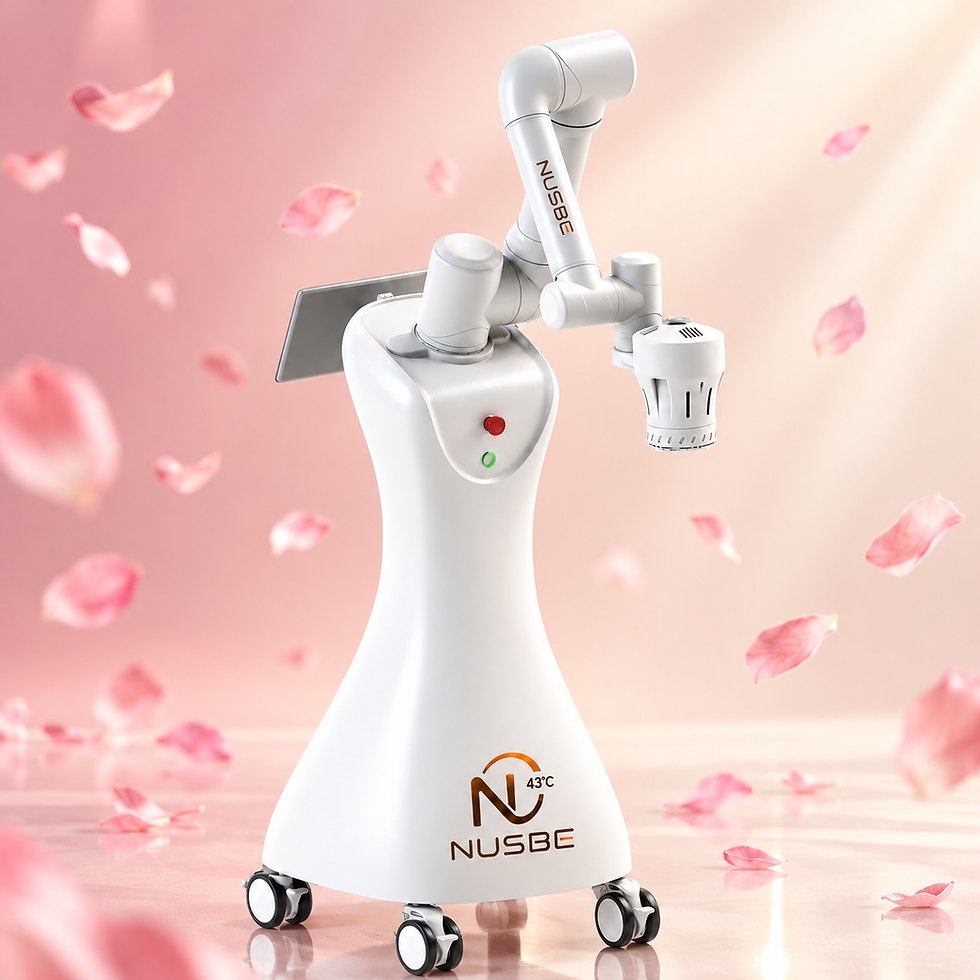
NUSBE is the AI robotic massage and robotic thermotherapy brand of Zeze Intelligence, with a flagship branch at NUSBE Rimbayu in Selangor, Malaysia. The NUSBE M1 combines body-contour mapping with a 3D imaging system, infrared temperature monitoring, a 6-axis, 7-joint robotic arm, and multi-joint force sensing with live force and temperature tracking, while a trained operator stays responsible for every session. It evolved from the NUSBE M2, an operator-guided thermal therapy device. You can explore each component on the NUSBE technology page.
For salons, spas, gyms and hotels, NUSBE also runs a partner programme that combines the M1 robotic thermotherapy, M2 thermal therapy and M3 thermal percussion devices with operator training and launch support. Details are on the NUSBE for business page.
Frequently asked questions
Is AI robotic massage safe?
Controlled studies so far have not reported adverse effects from robotic sessions, and modern systems use force limits, temperature limits and emergency stops. Safety still depends on the specific device, correct setup and supervision. Anyone who is pregnant, has a medical condition, an injury or new or unexplained pain should speak to a healthcare professional first.
Can a robot replace a human massage therapist?
Not on current evidence. In a randomized crossover trial, robotic and manual massage both improved relaxation, but manual massage delivered additional benefits for mood, well-being and muscle pain. Robotic systems are best seen as a consistent, supervised complement to human therapists.
How is robotic massage different from a massage chair?
A massage chair runs fixed rollers along preset tracks. An AI robotic massage system maps the individual body first, then moves a robotic arm along a planned path while sensors continuously measure contact force and, in thermal systems, temperature.
What is robotic thermotherapy?
Robotic thermotherapy uses a robotic arm to move a heat applicator across the body along a planned path, with temperature and force monitored during the session. It combines the comfort of warmth with the consistency of guided robotic movement.
Is robotic massage a good investment for a spa or gym?
It can be, but it depends on your client base, pricing, floor space and the supplier's business model. Compare total cost of ownership, training and support, and the realistic number of sessions you can sell each week before committing.
The bottom line
AI robotic massage brings together computer vision, force sensing and robotic motion to deliver consistent, repeatable recovery sessions. Early research is encouraging on safety and relaxation, and at least one trial shows results comparable to standard care for low back pain, but human therapists still offer benefits robots have not matched. For operators, the opportunity is real, and the smartest approach is to evaluate the technology, the supervision model and the business economics together.
To see how one robotic thermotherapy system is built, visit the NUSBE technology page, or explore the NUSBE partner programme for spas, gyms and hotels.
Explore robotic wellness for your business
Planning an AI robotic wellness service in Malaysia? Compare the ZEZE robotics catalogue and review the M1 Thermal equipment details to assess which model fits your service. You can also book a live robotics demonstration to discuss your space, workflow and equipment needs.
For supervised equipment practice and business planning, explore AI Robotic Wellness Masterclass with Yen at NUSBE Rimbayu. Register interest to receive the confirmed dates, fees and enrolment details.
This article is for general information and is not medical advice. Always consult a qualified healthcare professional about pain, injury or medical conditions.


Comments