
AI Scalp Scanners in Singapore: HSA Regulations, Compliance, and the Future of Wellness Technology

Updated: Sep 12, 2025
Published by Zeze Intel | 2025 Research Report
Executive Summary
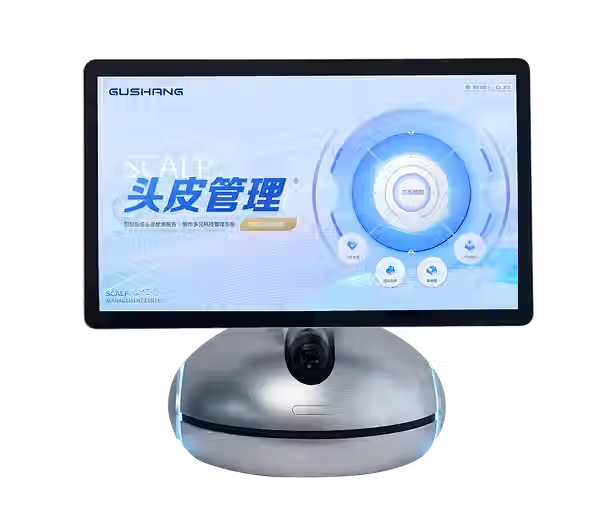
Artificial intelligence (AI) scalp scanners are becoming a key technology in the wellness and beauty industry. These devices provide high-resolution imaging of the scalp and hair follicles, enhancing consultations, improving client trust, and supporting treatments such as headspa therapy.
In Singapore, the Health Sciences Authority (HSA) is responsible for regulating health products under the Health Products Act (2007). Whether an AI scalp scanner is considered a Software as a Medical Device (SaMD) or a cosmetic wellness device depends on its intended use and the claims made in marketing and product documentation.
1. The Role of the Health Sciences Authority (HSA)

The Health Sciences Authority (HSA) is Singapore’s statutory body regulating pharmaceuticals, cosmetics, and medical devices. Its role includes
Registering medical devices before they are supplied in the market
Licensing manufacturers, importers, and distributors
Monitoring advertising claims for accuracy and compliance
Enforcing the Health Products Act (2007) through investigations, recalls, fines, and penalties
The Health Products Act (2007), supported by the Health Products (Medical Devices) Regulations 2010, forms the legal foundation for medical device regulation. For AI technologies, HSA issues detailed guidance documents such as GL-04 R3 (2024), GN-37 R1 (2024), and the 2025 SaMD Risk Classification Update.
2. HSA’s Regulatory Framework for AI and SaMD

A product is classified as a medical device if it is:
Intended for diagnosis, prevention, monitoring, or treatment of disease, or
Influences physiological processes with a medical objective

For AI scalp scanners, this means:
Medical Device (SaMD): If marketed as diagnosing alopecia, dandruff, or scalp conditions, the device requires registration with HSA
Wellness Device: If marketed as a cosmetic or wellness tool for relaxation, scalp comfort, beauty consultations, or visual tracking of cosmetic improvements, it is not classified as a medical device
HSA’s updated guidance (2024–2025) emphasizes lifecycle management of SaMD, change management for AI/ML-enabled devices, and risk-based classification.
3. Grey Area: Cosmetic vs. Medical Use


AI scalp scanners occupy a regulatory grey area. The technology itself may highlight features associated with medical conditions, but HSA focuses on intended use and claims:
Cosmetic / Wellness Positioning
Claims about relaxation, scalp comfort, or beauty outcomes
Not regulated as a medical device
Medical Positioning
Claims about diagnosis, disease detection, or treatment monitoring
Classified as SaMD and subject to HSA regulation
👉 Businesses must ensure marketing materials, packaging, and distributor training are aligned with the wellness positioning to avoid enforcement risks.
4. Penalties Under the Health Products Act

Failure to comply with HSA requirements carries significant legal risks:
Importing or selling an unregistered medical device: Fine up to SGD 50,000, imprisonment up to 2 years, or both
Continuing offences: Additional fine of SGD 1,000 per day
False or misleading advertising: Fines, corrective orders, advertising bans
Failure to meet post-market obligations: Licence suspension and monetary penalties
These penalties highlight the importance of clear regulatory positioning and strict compliance protocols.
5. Import and Usage Protocol in Singapore
To ensure smooth entry and operation:
Importation: Declare scanners as cosmetic or wellness devices under HS codes for beauty equipment. Submit product manuals and disclaimers if requested
Marketing: Use non-medical terminology (e.g., scalp comfort, hydration, relaxation). Avoid diagnostic or treatment claims
Labeling: Add disclaimers: “This device is intended for cosmetic and wellness use only. It is not intended to diagnose, treat, cure, or prevent medical conditions.”
Distributor Training: Ensure salons and headspa partners use compliant scripts. Monitor social media for medical claims
Data Governance: Comply with the Personal Data Protection Act (PDPA) for scalp images and client data

6. Preparing for Future Regulatory Tightening
The regulatory environment for AI in beauty and wellness is dynamic. Singapore, along with other ASEAN countries, is aligning under the ASEAN Medical Device Directive (AMDD).

Possible scenarios include:

Best Case (2025–2027): Wellness devices remain exempt
Medium Case (2027–2029): Notification regime introduced, requiring basic product dossiers
Worst Case (2029 onwards): All AI scalp scanners classified as SaMD, requiring full HSA registration and quality management compliance
Preparation steps:
Maintain a compliance dossier (intended use, disclaimers, risk analysis)
Align with ISO 13485 quality principles
Collect non-medical wellness data to differentiate from clinical devices
Engage with HSA for early classification feedback
7. Strategic Business Implications
Compliance as Differentiator: Businesses that align with HSA guidance gain credibility with investors, distributors, and clients
Risk Management: Proper positioning avoids recalls, reputational harm, and penalties
Regional Expansion: HSA compliance readiness supports scaling into Malaysia, Thailand, and Indonesia under AMDD
Future-Proofing: Preparing now ensures adaptability when laws evolve
Conclusion

AI scalp scanners represent a powerful innovation for Singapore’s beauty and wellness industry. Success depends on responsible regulatory positioning:
Position scanners as cosmetic and wellness tools, not medical devices
Implement disclaimers, import protocols, and compliance training
Prepare for future regulatory tightening by maintaining documentation and aligning with international standards
By balancing innovation with compliance, Zeze Intel ensures sustainable growth in Singapore’s regulated market while maintaining trust with regulators, partners, and clients.
Frequently Asked Questions (FAQ)
Q1: How can I future-proof my salon with ZezeIntel?
A: By booking a live demo, you’ll see how our science-backed scalp insights strengthen customer trust and increase sales. 💡 Learn more in our blog.
Q2: What makes ZezeIntel’s scalp insights different from regular scalp analysis?
A: Our technology combines AI-driven scanning with dermatology-backed research, giving salon owners more accurate and credible results. Discover the details in our latest article.
Q3: Will this technology really help me boost client loyalty?
A: Yes. Transparency builds trust — when clients see objective scalp data, they’re more likely to believe in your recommendations. We’ve explained real salon success stories in our blog section.
Q4: Is ZezeIntel’s system compliant with health regulations?
A: Absolutely. We follow local authority guidelines (e.g., HSA, MDA, MoH, TFDA). For a deeper dive into regulations and compliance, check out our compliance blog post.
Q5: How do I get started?
A: It’s simple — book your live demo today and explore how ZezeIntel can elevate your salon’s professionalism and profitability. Ready to begin? 👉 Schedule now.
⚠ Disclaimer
The views expressed in this article are solely those of the author and do not represent medical, legal, or regulatory advice. The content is intended for educational and informational purposes only. Zeze Intel makes no medical or regulatory claims.
Always seek guidance from a qualified healthcare professional and verify with your local regulatory authority (e.g., MDA, HSA, TFDA, MoH) before making any healthcare or business decisions involving AI health scanners.
References
Health Sciences Authority (HSA). Regulatory Guidelines for Software Medical Devices (GL-04 R3, 2024). https://www.hsa.gov.sg/docs/default-source/hprg-mdb/guidance-documents-for-medical-devices/gl-04-r3-regulatory-guidelines-for-software-medical-devices---a-life-cycle-approach-(2024-mar)-pub.pdf?sfvrsn=bbb0bdd2_4
Health Sciences Authority (HSA). Guidance on Change Management Program for SaMD (GN-37 R1, 2024). https://www.hsa.gov.sg/docs/default-source/hprg-mdb/guidance-documents-for-medical-devices/gn-37-r1-guidance-on-change-management-program-(cmp)-for-samd-including-machine-learning-enabled-samd.pdf?sfvrsn=143fb54a_1
Health Sciences Authority (HSA). Risk Classification of SaMD and CDSS (2025 Update).
Singapore Statutes Online. Health Products Act (2007). https://sso.agc.gov.sg/Act/HPA2007
Singapore Statutes Online. Health Products (Medical Devices) Regulations 2010. https://sso.agc.gov.sg/SL/HPA2007-S436-2010
Singapore Statutes Online. Personal Data Protection Act (PDPA) 2012. https://sso.agc.gov.sg/Act/PDPA2012
ASEAN. ASEAN Medical Device Directive (AMDD), September 2015. https://asean.org/wp-content/uploads/2016/06/22.-September-2015-ASEAN-Medical-Device-Directive.pdf

Comments